Compost is a wonderful soil amendment and very easy to make. You need organic matter, moisture, oxygen, and bacteria.
Compost bin
Containers need to have plenty of ventilation and some moisture.
Nothing. Compost can be created by making a 6x6x5 foot pile of alternating brown and green debris. The brown supplies carbon, the green supplies nitrogen.
Chicken wire in a cylinder. Mount 2 stakes in the ground and wrap chicken wire around it. Remove the chicken wire, turn the compost, put the compost back in chicken wire receptacle. The cylinder should be about 3 feet in diameter and 3 to 4 feet tall.
A homemade container can be made by taking a small garbage can and perforating it with 1/4 inch holes on the sides and bottom. A closed container has the advantage of keeping critters out better and hiding the contents from the neighbors.
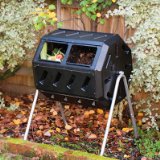 Compost tumblers have an advantage of being easy to turn the compost material. They do not hold as much as a garbage can.
How to make compost
Construct a pile 4 to 6 feet tall. Start off with a 6 inch layer of brown material followed by 3 inches of green material.
One layer is (green) plant debris, which adds nitrogen.
- leaves
- grass clippings
- unseeded weeds
- kitchen scraps
- vegetable and fruit scraps
- coffee grounds
- breads
- pastas
- tea bags
- ground egg shells
6 to 8 inches deep followed by 1 to 2 inches of (brown) debris, which adds carbon:
- cow manure
- topsoil
- dried leaves
- dried grass clippings
- shredded newspaper (not colored ads)
- straw
- hay
- sawdust
- nitrogen-rich fertilizer
- soil
- twigs
Do not use:
- poisonous plants (e.g. poison ivy)
- meat
- fat
- bones
- dairy products
- oils
- diseased plants
- pesticides
- used kitty litter
- garden plant roots
- plastics
- styrofoam
- medical waste
- batteries
- diapers
Chop or grind large materials into small pieces. Run over stuff with a lawnmower. Use a leaf sucker that chops up leaves.
Keep compost moist but not soggy nor dry. It should have consistency of a wrung-out sponge. Add a thin layer of soil every once in a while. Soil is rich in microbes.
Turn the compost pile every week or so. This reduces odors and helps compost decompose evenly. Compost should be ready in 1 to 3 months.
Before using compost, sift it through a 1 inch mesh screen, like chicken wire. Chop up the pieces left over.
In order to get the composting kickstarted, your pile needs to be hot and wet. The two biggest problems a compost system encounters are lack of heat and lack of moisture. These affect the composting process in different ways.
- Try to keep the internal heat of your compost bin at 110 °F (43 °C) or higher. Between 110 °F (43 °C) and 140 °F (60 °C) is the ideal temperature for your pile. If your pile dips below 110 °F (43 °C), consider adding more green nitrogen-rich material or more water.
- Try to keep the compost pile damp throughout — never soaked and never dry. A moist pile will heat up more efficiently, allowing for better composing in the end
- New compost needs more water than a partially rotted one.
- Don’t get the compost too wet
Tips
Use a lawnmower or leaf picker-upper to chop leaves into a fine mulch. The mulch can be left on the ground or added to the compost pile.
Keep the composter in a sunny area to speed up decomposition and keep out ants.
Bury kitchen scraps under at least 10 inches of compost in the bin so the smell does not attract animals or flies.
If there are a lot of ants, that is a sign the compost is not being turned enough.
Build three containers: one for composting, one for soil to add to compost, one for starting compost.
Turn the compost often.
Composting process
The composting process involves four main components: organic matter, moisture, oxygen, and bacteria.
Organic matter includes plant materials and some animal manures. Organic materials used for compost should include a mixture of brown organic material (dead leaves, twigs, manure) and green organic material (lawn clippings, fruit rinds, etc.). Brown materials supply carbon, while green materials supply nitrogen. The best ratio is 1 part green to 1 part brown material. Shredding, chopping or mowing these materials into smaller pieces will help speed the composting process by increasing the surface area.
For piles that have mostly brown material (dead leaves), try adding a handful of commercial 10-10-10 fertilizer to supply nitrogen and speed the compost process.
Moisture is important to support the composting process. Compost should be comparable to the wetness of a wrung-out sponge.
If the pile is too dry, materials will decompose very slowly. Add water during dry periods or when adding large amounts of brown organic material.
If the pile is too wet, turn the pile and mix the materials. Another option is to add dry, brown organic materials.
Oxygen is needed to support the breakdown of plant material by bacteria. To supply oxygen, you will need to turn the compost pile so that materials at the edges are brought to the center of the pile. Turning the pile is important for complete composting and for controlling odor.
Wait at least two weeks before turning the pile, to allow the center of the pile to “heat up” and decompose. Once the pile has cooled in the center, decomposition of the materials has taken place. Frequent turning will help speed the composting process.
Bacteria and other microorganisms are the real workers in the compost process. By supplying organic materials, water, and oxygen, the already present bacteria will break down the plant material into useful compost for the garden. As the bacteria decompose the materials, they release heat, which is concentrated in the center of the pile.
You may also add layers of soil or finished compost to supply more bacteria and speed the composting process. Commercial starters are available but should not be necessary for compost piles that have a proper carbon to nitrogen ratio (1 part green organic material to 1 part brown organic material).
In addition to bacteria, larger organisms including insects and earthworms are active composters. These organisms break down large materials in the compost pile.
How long does it take?
The amount of time needed to produce compost depends on several factors, including the size of the compost pile, the types of materials, the surface area of the materials, and the number of times the pile is turned.
For most efficient composting, use a pile that is between 3 feet cubed and 5 feet cubed (27-125 cu. ft.). This allows the center of the pile to heat up sufficiently to break down materials.
Smaller piles can be made but will take longer to produce finished compost. Larger piles can be made by increasing the length of the pile but limiting the height and the depth to 5 feet tall by 5 feet deep; however, large piles are limited by a person’s ability to turn the materials. You may also want to have two piles, one for finished compost ready to use in the garden, and the other for unfinished compost.
If the pile has more brown organic materials, it may take longer to compost. You can speed up the process by adding more green materials or a fertilizer with nitrogen (use one cup per 25 square feet).
The surface area of the materials effects the time needed for composting. By breaking materials down into smaller parts (chipping, shredding, mulching leaves), the surface area of the materials will increase. This helps the bacteria to more quickly break down materials into compost.
Finally, the number of times the pile is turned influences composting speed. By turning more frequently (about every 2-4 weeks), you will produce compost more quickly. Waiting at least two weeks allows the center of the pile to heat up and promotes maximum bacterial activity. The average composter turns the pile every 4-5 weeks.
When turning the compost pile, make sure that materials in the center are brought to the outsides, and that materials from the outside edges are brought to the center.
With frequent turning, compost can be ready in about 3 months, depending on the time of year. In winter, the activity of the bacteria slows, and it is recommended that you stop turning the pile after November to keep heat from escaping the pile’s center. In summer, warm temperatures encourage bacterial activity and the composting process is quicker
Troubleshooting
The compost has a bad odor
Problem: Not enough air. Not enough water. Too small.
Solutions: Turn it, add dry material if the pile is too wet.
The center of the pile is dry
Problem: Lack of nitrogen.
Solutions: Moisten and turn the pile.
The compost is damp and warm only in the middle
Problem: Pile is too small.
Solutions: Collect more material and mix the old ingredients into a new pile.
The heap is damp and sweet-smelling but still will not heat up
Problem: Lack of nitrogen.
Solutions: Mix in a nitrogen source like fresh grass clippings, manure or fertilizer.
Large, undecomposed items are still in the mix
Problem: Low surface area.
Solutions: Remove items, and chop or shred large items.
References
http://whatcom.wsu.edu/ag/compost/fundamentals/needs_temperature.htm
http://whatcom.wsu.edu/ag/compost/fundamentals/needs_temperature.htm